Where AI Fits in Modern Marketing Workflows
Marketing has always been about timing, relevance, and consistency. The challenge is that most teams are expected to deliver all three—across multiple channels, large audiences, and limited time.
That’s where AI starts to change how work gets done.
Instead of relying on fixed rules or one-size-fits-all campaigns, AI helps marketing systems respond to real user behavior. It looks at what people click, read, ignore, and buy—and adjusts messaging, timing, and experiences accordingly.
This shift is already visible across email, content, paid media, personalization, video, and automation. In each of these areas, AI reduces manual effort and aligns campaigns more closely with what users actually want.
In this blog, we’ll look at how AI is being used across key marketing functions, what it does in practice, and how it improves results.
Email remains one of the most reliable and cost-efficient marketing channels. Even small improvements in open rates or click-through rates can make a noticeable difference. The challenge is scale; testing countless combinations of subject lines, content, timing, and offers manually is difficult and time-consuming.
According to Campaign Monitor, segmented email campaigns can lead to a 760% increase in revenue.
This is where AI helps.
AI systems analyze customer behavior and past performance to make decisions automatically, often built through an AI development service designed for scalable marketing automation. Instead of sending the same email to everyone, they tailor each message based on what is most likely to work for that individual.
What AI can do in email marketing:
- Personalize content: Select the most relevant subject line, body copy, CTA, and offer for each recipient
- Optimize timing: Send emails when each user is most likely to open and engage
- Run continuous experiments: Test multiple combinations of content and timing at scale
- Guide user journeys: Move users into the right email flows based on their actions and engagement
In practice, AI improves four key areas: message, offer, timing, and journey placement—all based on real user signals.
How this improves results:
- Higher open rates: AI can identify subject lines that resonate with different audience segments. For example, a more casual tone or the use of emojis might work better for some users, while others respond to more direct messaging.
- Better click-through rates: Email content can be adjusted based on preferences, location, or past behavior—such as promoting winter products to colder regions and summer items to warmer ones.
Tools that support AI-driven email marketing:
- Hightouch – Uses AI decisioning to optimize messaging, timing, and channels based on customer data
- ActiveCampaign – Offers AI features for generating subject lines, email copy, and automated journeys
- Mailchimp – Provides AI-based audience segmentation, design suggestions, and accessibility features
- Klaviyo – Helps refine content, suggest layouts, and recommend products for campaigns
By using AI, teams can move beyond manual testing and build email campaigns that adapt continuously to user behavior, improving engagement over time.
AI in human resources
HR teams are responsible for some of the most time-sensitive and detail-heavy work in any organization — from onboarding new hires and managing compliance to running performance cycles and processing payroll. Yet many teams are still spending the bulk of their time on manual, repetitive tasks that leave little room for the strategic work that actually moves the needle.
According to Omni’s State of AI in HR 2026 report, 1 in 2 HR leaders say fragmented data is already limiting their ability to adopt AI — making disconnected systems the single biggest barrier to adoption, ahead of budget or buy-in.
AI helps by handling the administrative load — so HR teams can focus less on process management and more on people.
What AI can do in HR:
- Automate routine workflows: Trigger onboarding tasks, document requests, and approvals without manual follow-up
- Streamline hiring: Screen applications, flag strong candidates, and reduce time-to-hire
- Support performance management: Surface insights from review cycles, flag engagement risks, and track goal progress
- Simplify compliance: Flag missing documentation, monitor policy acknowledgments, and keep records audit-ready
- Improve reporting: Generate workforce analytics and payroll summaries without manual data pulls
In practice, AI works best when it’s embedded directly into the HR platform your team already uses — not bolted on as a separate tool.
How this improves results:
- Fewer errors: Automated data entry and validation reduce the risk of payroll mistakes and compliance gaps
- Faster onboarding: Automated task flows get new hires up to speed without HR chasing signatures and paperwork
- Better visibility: Real-time dashboards give HR leaders an accurate picture of headcount, costs, and team health at any point in time
- More strategic HR: With admin handled, HR teams can dedicate more time to retention, development, and workforce planning.
Tools that support AI-driven HR:
- Omni HR – Automates HR workflows, payroll, and compliance for multi-country teams across Asia-Pacific, with AI capabilities built into the platform
- Workday – Enterprise-grade HRIS with AI-powered workforce planning and analytics
- Eightfold AI – Uses AI for talent intelligence, skills mapping, and workforce planning
By integrating AI into HR operations, teams can reduce manual workload, improve data accuracy, and create a better experience for employees — without adding headcount or complexity.
AI in content marketing
Content marketing helps build credibility, improve visibility, and bring consistent traffic to your website. Most teams already know what kind of content performs well—but limited time and resources often slow down execution.
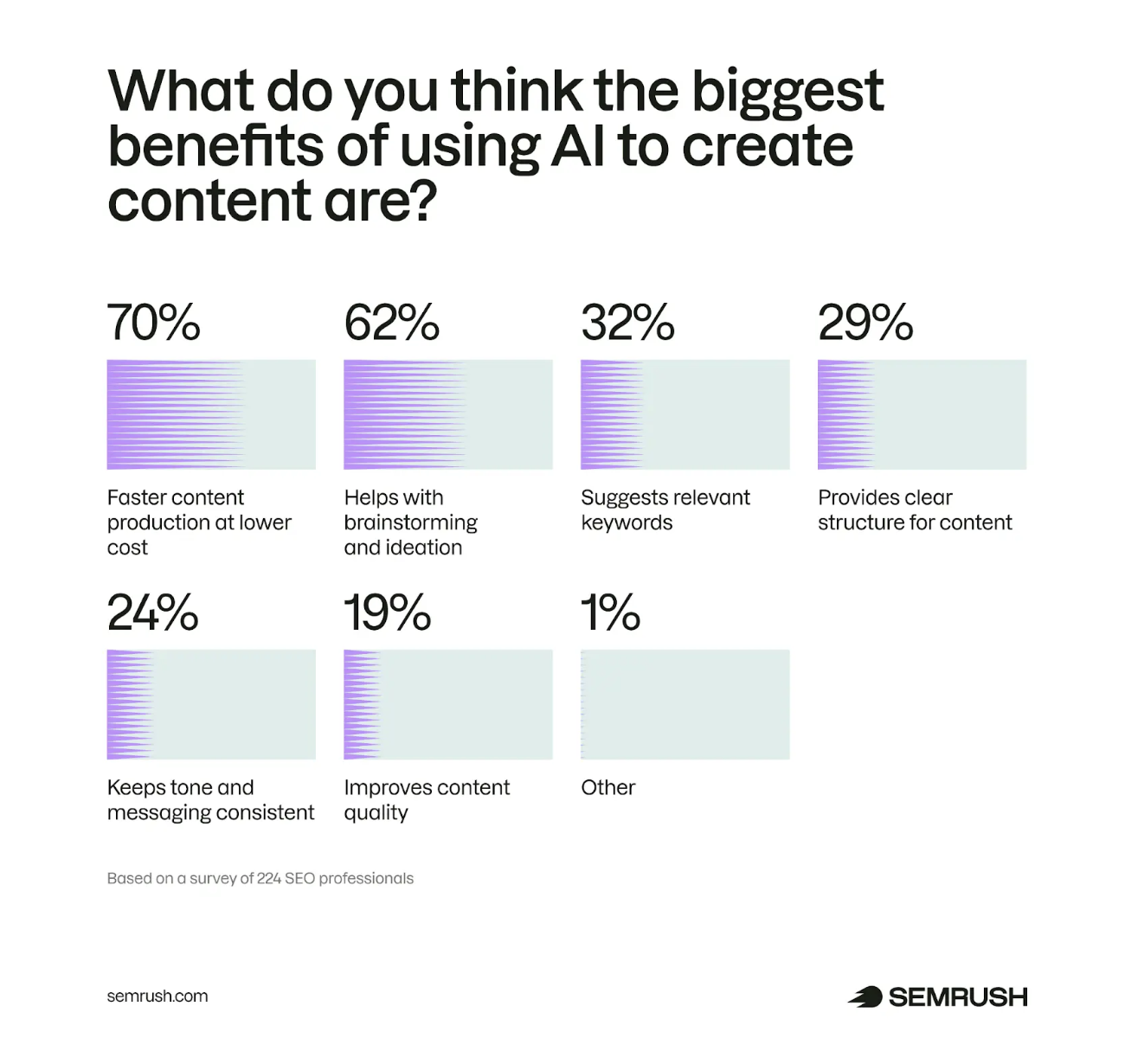
According to a Semrush study of 224 SEO professionals, 70% of SEO teams cite faster content production as the top benefit of using AI.
AI helps by reducing the manual work involved in research, writing, and distribution, allowing teams to focus more on strategy.
What AI can do in content marketing:
- Identify high-impact topics: Analyze search demand, competition, and user intent to suggest content ideas
- Speed up production: Generate briefs, outlines, and first drafts to reduce writing time
- Improve quality: Refine structure, clarity, and tone to match the target audience
- Scale distribution: Automate scheduling, repurpose content, and reshare it across channels
In practice, AI supports both content creation and distribution, helping teams maintain consistency without increasing workload.
How this improves results:
- Stronger content engagement: AI can generate visuals, videos, or supporting media to make content easier to understand and more engaging
- Consistent publishing: Automated scheduling ensures content goes live at the right time and can be reshared to extend reach
- Faster research: AI can identify trending topics and gather relevant insights, helping teams create content that aligns with current demand. For example, service-based industries like cleaning businesses can use AI to identify local search trends, common customer queries, and seasonal demand patterns.
Tools that support AI-driven content marketing:
- Jasper – Helps generate long-form content, content ideas, and SEO-focused elements like headlines and meta descriptions
- Grammarly – Improves clarity, grammar, and tone to match your audience
- Copy.ai – Creates articles, social posts, and ad copy while assisting with research tasks
- Writesonic – Generates articles, ad copy, product descriptions, and includes SEO and media features
By integrating AI into content workflows, teams can produce more content, maintain quality, and keep distribution consistent—without getting overwhelmed by repetitive tasks.
AI in paid media
Paid media helps businesses reach new audiences and deliver targeted messages. But when campaigns rely on broad audience segments and generic creatives, performance often suffers. AI improves this by making campaigns more precise and responsive to real user behavior.
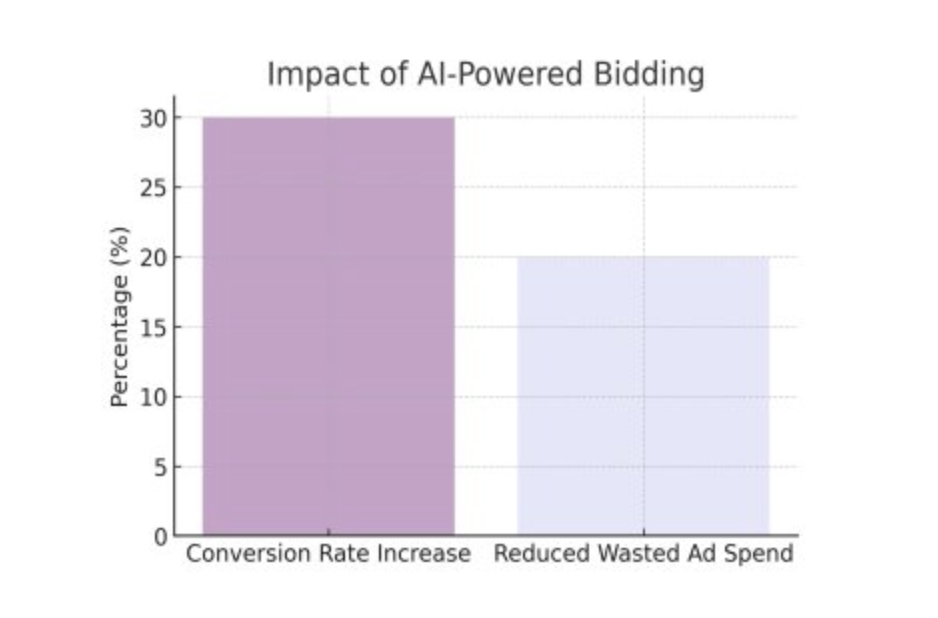
AI-powered bidding can improve conversion rates by up to 30% and reduce wasted ad spend by nearly 20%.
What AI does in paid media:
- Tests combinations at scale: Experiments with different creatives, audiences, and placements simultaneously
- Adjusts budgets dynamically: Shifts spend toward ads that are driving better results
- Optimizes bids and timing: Makes real-time adjustments to improve delivery and performance
- Refines targeting: Focuses on conversion and revenue signals, not just clicks
In simple terms, AI helps improve ROAS (return on ad spend) by continuously learning what works and allocating resources accordingly.
How this improves campaign performance:
- More precise ad placements: AI can identify users who are already showing intent and place ads at the right moment
- Better conversions: By matching the right creative with the right audience, campaigns become more relevant
- Reduced manual work: Automation handles tasks like campaign setup, copy generation, and performance tracking
Tools that support AI-driven paid media:
- AdCreative.ai – Generates ad creatives, analyzes performance, and provides insights into what works
- The Trade Desk (Kokai platform) – Automates media buying, optimizes bids, and refines targeting based on user behavior
By using AI in paid media, businesses can move beyond basic segmentation and run campaigns that adapt continuously, improving efficiency and overall results.
AI in video marketing
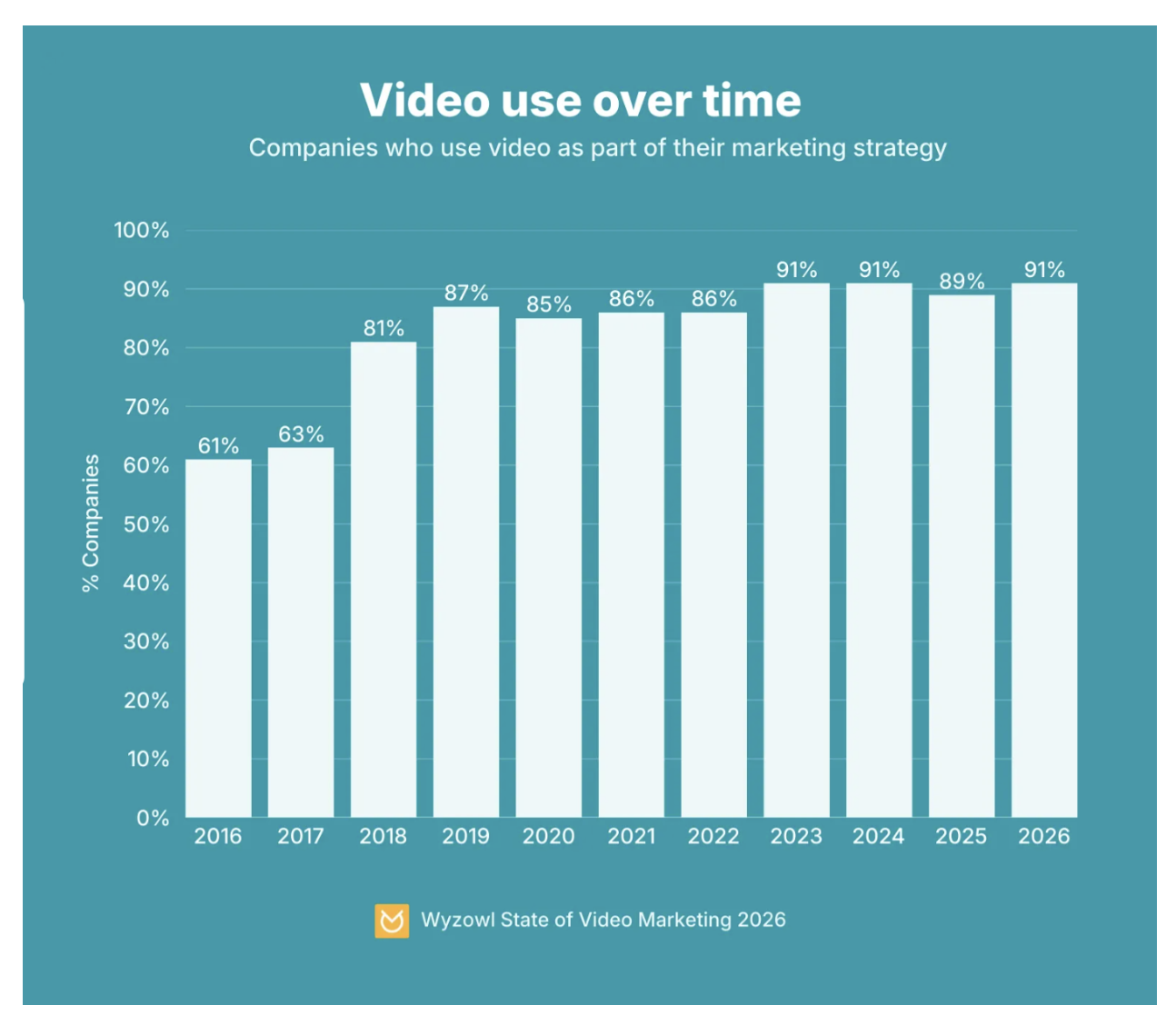
As of 2026, 91% of businesses use video as a marketing tool.
Video performance often depends on engagement metrics like watch time and click-through rate. Consistently creating high-quality videos can be time-consuming, especially when editing and production take up most of the effort. AI helps simplify these tasks so teams can focus more on content and strategy, including using tools that support ai text to video generator workflows to quickly turn ideas into usable video assets.
What AI does in video marketing:
- Automates editing: Removes filler words, pauses, and mistakes to create cleaner videos
- Improves quality: Enhances visuals with noise reduction, color correction, and stabilization
- Generates transcripts and captions: Makes videos more accessible and easier to reuse across formats
- Creates new assets: Produces stock footage or AI-generated avatars for different use cases
How this helps in practice:
- Faster editing: AI can quickly refine videos, such as polishing customer testimonials by removing pauses or errors
- Better accessibility: Auto-generated captions help reach a wider audience, including non-native speakers
- More engaging visuals: AI-generated footage can add variety without relying on expensive resources
- Scalable content creation: AI avatars can deliver scripts in multiple languages, making it easier to create localized content
For teams distributing video across global markets, knowing and choosing the best video translator apps is just as important as the production process itself. The right tool can automate dubbing, captions, and localization without adding manual effort.
Tools that support AI-driven video marketing:
- Synthesia – Creates videos using AI avatars with support for multiple languages
- D-ID – Enables interactive AI avatar video creation focused on conversational experiences
- Runway – Generates and edits video content based on prompts
- Veed.io – Offers AI-powered editing features like captioning and audio enhancement
By reducing the effort required for editing and production, AI helps teams create more video content while maintaining quality and consistency.
AI in marketing automation
Nucleus Research found that marketing automation can increase sales productivity by 14.5% and reduce marketing overhead by 12.2%.
Many marketing tasks are repetitive, moving data between tools, sending messages, running campaigns, or scheduling content. These activities take time but don’t always require manual effort. As workflows become more complex, many teams also rely on Webflow-focused development teams to integrate tools, streamline systems, and reduce operational overhead without increasing internal workload.
As organizations scale, hiring complexity increases across regions, roles, and compliance requirements. This is where enterprise recruitment software becomes critical, enabling centralized hiring workflows, structured interviews, and consistent candidate evaluation at scale.
Traditional automation follows fixed rules. AI-driven automation goes further by learning from data and improving workflows over time. It connects customer signals to actions, so messages and experiences are triggered based on behavior rather than static schedules.
What AI does in marketing automation:
- Automates routine tasks across tools and channels
- Builds personalized journeys based on user behavior and intent
- Triggers actions in real time using customer and product signals
- Improves workflows continuously by learning from performance data
Instead of running predefined sequences, AI adapts as customers interact with your brand.
How this works in practice:
- Customer onboarding: AI can tailor onboarding flows based on what users explore or interact with, helping them reach value faster
- Journey orchestration: It adjusts messaging across channels—email, in-app, WhatsApp, or notifications—based on real-time engagement
- Sales outreach: AI can identify high-intent prospects and send personalized messages at the right moment, based on their activity and context
Tools that support AI-driven marketing automation:
- UnifyGTM – Automates outbound workflows, identifies potential buyers, and manages outreach using AI agents
By shifting from fixed workflows to adaptive systems, AI helps marketing teams reduce manual work while delivering more relevant and timely customer experiences.
Conclusion
AI is not replacing marketing; it’s changing how decisions are made and how work is executed.
Across email, content, paid media, personalization, video, and automation, one pattern is clear: systems are moving from static setups to ones that adjust based on user behavior. Instead of guessing what might work, teams can rely on signals from real interactions.
This doesn’t remove the need for strategy or creativity. It shifts the focus. Less time goes into repetitive tasks and manual testing, and more time goes into understanding customers, shaping ideas, and guiding direction.
The result is not just better performance metrics but also marketing that feels more relevant and timely for the people receiving it.