Summary: AI is no longer something groundbreaking. It's expected. So, you can't base your entire marketing strategy around the generic message "Learn AI." You must showcase how your AI courses improve people's skills and elevate their daily work. Stick with us, and we'll explain how.
How To Market AI Training Courses The Right Way
Demand for AI skills is rising, but so is the number of courses, workshops, certifications, and training providers competing for attention. If you are wondering how to market AI training courses, you need to look beyond course topics and focus on the value your program can deliver. That makes "Learn AI" an increasingly weak marketing message. In 2025, the World Economic Forum found that 77% of employers planned to upskill their workforce in response to AI-related changes, while 63% identified skills gaps as a major barrier to business transformation.
For individuals, effective AI course marketing means showing how training can improve their work, employability, confidence, or career prospects. Employers, meanwhile, want evidence that a program can improve AI adoption, productivity, governance, and business performance. They also want to know whether the training fits their teams and existing workflows.
Therefore, your job is to make the value of your offer clear. If you want to understand how to differentiate an AI training program, start by defining who it serves, which workplace problems it addresses, what participants will be able to do afterward, and why they should trust your expertise. These details can help you respond to changing AI skills gap trends while making workforce upskilling more practical and relevant.
Our guide explains how to position, promote, and sell AI training courses, workshops, and corporate upskilling programs to both individual learners and organizational buyers. It will show you how to turn your training offer into a clear proposition, generate demand, and convert interest into enrollments and corporate contracts.
TL;DR
- Avoid marketing a broad promise such as "master AI."
- Define the learner, use case, skill level, and business outcome.
- Separate individual learner campaigns from corporate training campaigns.
- Use practical proof, instructor credibility, sample lessons, and learner outcomes to reduce perceived risk.
- Build different funnels for workshops, self-paced courses, certifications, and enterprise programs.
- Measure qualified enrollments, completion, skill application, corporate pipeline, and repeat business—not only traffic or registrations.
Are you looking to invest in the right AI tools?
Visit our directory, discover and compare tools, and pick your ideal option.
In This Guide, You Will Find...
- Why AI Training Is A Growing But Crowded Market
- Start By Defining What Kind Of AI Training You Sell
- How To Start Market AI Training Courses: Identify The Real Buyer
- Segment The Market By AI Use Case
- Sell Outcomes, Not Course Modules
- Create A Differentiated Value Proposition
- How To Market AI Training Courses: Find Your Ideal Buyers
- Package AI Training Around Buyer Readiness
- Build A High-Converting Course Landing Page
- Use Content Marketing To Build Demand Before Asking For Enrollment
- Build An SEO And GEO Strategy For AI Course Discovery
- Promote AI Courses Through LinkedIn
- Use Webinars And Workshops As Conversion Mechanisms
- Sell Corporate AI Training Through Consultative Marketing
- Demonstrate Instructor And Provider Credibility
- Use Proof That Matches The Buying Decision
- Create Urgency Without Manufacturing Hype
- Price And Package The Course Effectively
- Build An AI Training Campaign Funnel
- Measure AI Course Marketing Performance
- Common AI Course Marketing Mistakes
- How eLearning Industry Can Help Your Market Your AI Training Courses
Why AI Training Is A Growing But Crowded Market
AI is changing job requirements, daily workflows, and employer expectations across industries. The opportunity for AI training providers is clear: companies need people who can use AI tools effectively, while employees want practical skills that can help them perform better and remain competitive. However, strong demand does not automatically translate into course enrollments or corporate contracts.
If you want to market AI training courses, you are competing with a growing range of alternatives. Learners can choose free videos, vendor academies, university programs, online course marketplaces, bootcamps, independent creators, consultants, internal company training, and even AI-generated learning materials. This makes differentiation more important than ever.
For example, some learners may prefer self-paced learning because they want flexibility and a lower-cost option. Others may choose an instructor-led workshop because they need hands-on guidance and immediate answers. Companies may also compare your offer with internal training or consultants who already understand their business.
Therefore, your marketing needs to answer a more important question than whether AI matters. It needs to show why your program offers the right path to a specific result. Strong AI workshop marketing, for instance, should connect the workshop to a clear workplace need rather than simply listing topics. The same principle applies whether you sell courses, certifications, or an AI strategy program.
Start By Defining What Kind Of AI Training You Sell
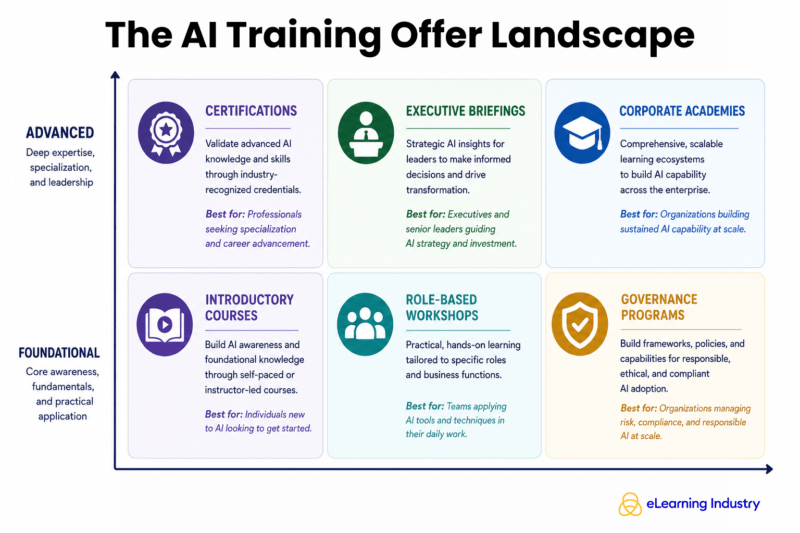
AI training is too broad to function as useful positioning. Before building a marketing strategy for AI course providers, you need to define exactly what you sell and why people should choose it. Separate your programs by format, audience, and buying motivation because each one attracts different prospects. This classification also affects your message, pricing, funnel, proof, sales process, channel mix, and conversion event. When you make these distinctions clear, you can create a stronger path toward course enrollment.
| Training offer | Primary buyer | Main motivation |
| Introductory course | Individual learner | Understand AI fundamentals |
| Role-based workshop | Professional or team leader | Apply AI to daily work |
| Certification program | Career-focused learner | Validate competence |
| Executive workshop | Leadership team | Make better strategic decisions |
| Corporate academy | L&D, HR, or transformation leader | Build workforce capability |
| Technical bootcamp | Technical professional or employer | Develop specialized skills |
| Governance training | Legal, compliance, risk, and leadership | Use AI responsibly |
| Train-the-trainer program | L&D and internal educators | Scale AI learning internally |
How To Start Marketing AI Training Courses: Identify The Real Buyer
When you market AI training, remember that the person taking the course may not be the person making the buying decision. This distinction matters when you promote AI courses or try to sell AI training to companies because each stakeholder evaluates your offer differently.
Learner
- Will this help me do my job better?
- Is the training suitable for my current skill level?
- Will I receive useful templates, tools, or hands-on practice?
- Is the certificate credible and relevant to my career?
- How much time will I need to complete it?
Manager Or Department Head
- Will employee performance improve?
- Can participants apply what they learn immediately?
- Will the training fit the team's existing workflow?
- How will we measure progress and practical results?
L&D Or HR Leader
- Can the program scale across different teams?
- Does it address a verified skills gap?
- Can it integrate with our existing learning ecosystem?
- Will we receive useful reporting and learner data?
- Can you customize the content for our needs?
Executive Sponsor
- Will the program support our enterprise AI strategy?
- Can it improve productivity or reduce AI-related risks?
- How does it connect to our wider business priorities?
- What will our organization be able to do after training?
Procurement
- What does the program cost?
- What exactly does the price include?
- Can you support our required scale, timeline, and contractual requirements?
- What are the payment and purchasing terms?
When you market AI training courses, use messaging that addresses these different questions instead of relying on broad brand awareness campaign examples.
Segment The Market By AI Use Case
Do not position your training only around the AI topic you teach. To market AI training courses effectively, connect the program to a specific role, workplace context, and outcome. When people can immediately see how the training applies to their responsibilities, they have a stronger reason to consider it.
Weak Positioning:
- Generative AI Course
- ChatGPT Workshop
- AI for Business
Stronger Positioning:
- Generative AI for Marketing Teams
- Responsible AI for HR Leaders
- AI Productivity for Executive Assistants
- AI Governance for L&D Teams
- Prompt Engineering for Instructional Designers
- AI for Customer Support Managers
- AI strategy for business leaders
- AI Sales Enablement for B2B Teams
This approach also makes AI workshop marketing more targeted. Instead of trying to reach everyone interested in AI, you can create messaging around a specific audience and its needs. A training needs analysis can help you identify those needs, while AI readiness assessments can show you where the audience currently stands.
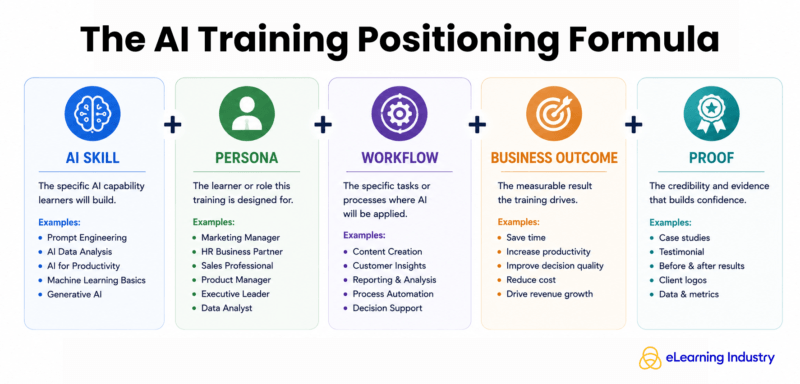
Use this practical positioning formula: AI capability + priority persona + workplace use case + measurable outcome
For example: "A practical AI workshop for HR teams that helps participants automate repetitive work while protecting employee and organizational data."
Sell Outcomes, Not Course Modules
Course providers often promote their syllabi instead of showing buyers what participants will achieve. Listing modules such as AI basics, prompt engineering guides, automation, ethics, and practical exercises tells people what you teach, but it does not explain why they should buy the training.
Instead of:
- Introduction to AI
- Prompt engineering
- AI tools
- Automation
- Ethics
- Practical exercises
Show what changes afterward:
- Participants can identify AI use cases relevant to their roles.
- Teams can create and improve prompts for common workplace tasks.
- Employees can automate repetitive processes and save time.
- Managers can identify common risks and make safer AI decisions.
- Participants can create a practical AI strategy roadmap for their team.
- Learners leave with a useful workflow, project, template, or implementation plan.
A strong course page should answer:
- What will participants know?
- What will they be able to do?
- Which tasks will become easier?
- Which risks will they manage better?
- What practical asset will they take back to work?
| Course content | Marketable outcome |
| Prompting fundamentals | Produce stronger outputs with fewer revisions |
| AI tool comparison | Select the right tools for specific workflows |
| Automation exercises | Reduce time spent on repetitive work |
| Responsible AI | Use AI without exposing sensitive data |
| AI strategy | Prioritize viable use cases and investments |
| Hands-on projects | Apply skills to real workplace scenarios |
| Governance modules | Create safer standards for organizational use |
Do you want to stay updated regarding the latest eLearning news? Subscribe to our newsletter and never miss a beat!
Create A Differentiated Value Proposition
The AI training market is full of similar promises, which makes it difficult for buyers to understand why they should choose one program over another. If you want to market AI training courses effectively, avoid relying on broad claims that could describe almost any program.
Avoid:
- Unlock the power of AI
- Future-proof your career
- Master AI
- Transform your business
- Become an AI expert
- Work smarter with AI
These phrases can support your messaging, but they rarely create strong differentiation on their own. Instead, build your value proposition around details that make your program more relevant and credible:
- Specific audience: Who exactly is the program for?
- Capability gap: What skill or problem does it address?
- Delivery method: Is it live, self-paced, cohort-based, or workshop-led?
- Instructor credibility: Why should learners trust your expertise?
- Practical application: How will participants practice what they learn?
- Support: What guidance do they receive during or after training?
- Outcome: What will they be able to achieve?
- Certification or proof: What evidence demonstrates their progress?
- Organizational relevance: How does the training support workforce upskilling and better AI investments?
Value-proposition template: [Program name] helps [specific learner] develop [specific capability] through [format or methodology], so they can [practical outcome] without [major risk or barrier].
For example: "AI for Learning Teams helps instructional designers and L&D leaders create, evaluate, and govern AI-assisted learning workflows through live demonstrations, guided practice, and role-specific templates."
How To Market AI Training Courses: Find Your Ideal Buyers
One of the first decisions you need to make is whether you are targeting individual learners or organizations. The two audiences have different motivations, buying processes, and conversion points, so you should not use the same messaging for both. If you are learning how to market instructor-led AI training, start by deciding who actually makes the purchase.
For individual learners, common motivations include career development, employability, confidence, productivity, certification, promotion, curiosity, and freelancing opportunities. They may discover your offer through YouTube, search, LinkedIn, creator partnerships, email, communities, or course marketplaces. Your conversion could be a course purchase, workshop registration, free trial, webinar signup, or lead magnet download. Cohort-based courses and role-based training can also appeal to learners looking for practical guidance.
Corporate buyers have different priorities, including workforce readiness, productivity, AI adoption, risk reduction, governance, standardized capability, and employee development. To market corporate training programs, you may need to guide prospects through a consultation, training-needs assessment, pilot workshop, proposal, corporate cohort, or annual agreement.
B2B acquisition often relies on thought leadership marketing, webinars, research, LinkedIn, industry publications, events, partnerships, sales outreach, and account-based marketing.
| Element | Individual learner | Corporate buyer |
| Core promise | Personal capability | Organizational impact |
| Decision cycle | Usually shorter | Longer and multi-stakeholder |
| Main proof | Reviews, samples, instructor | Case studies, outcomes, scalability |
| Main CTA | Enroll | Book a consultation |
| Pricing | Visible | Often customized |
| Sales involvement | Limited | Significant |
| Follow-up | Automated nurturing | Consultative selling |
Package AI Training Around Buyer Readiness
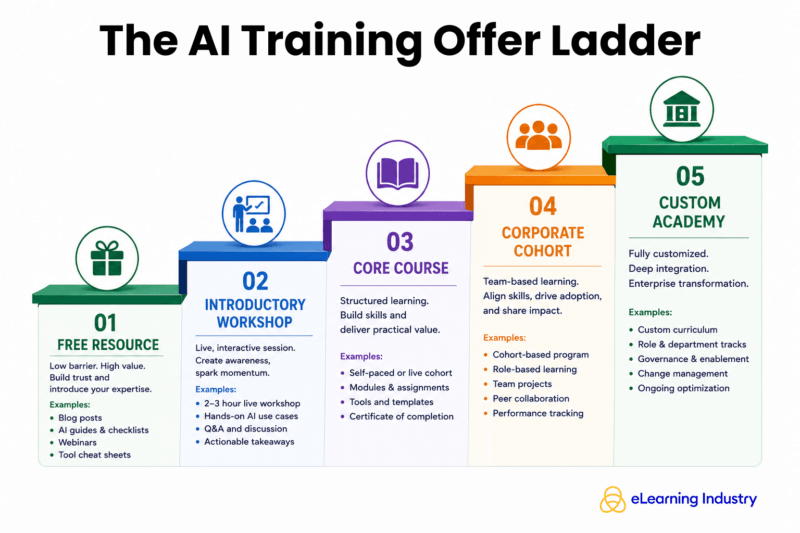
Not every prospect is ready to purchase a complete training program. Instead of sending everyone to the same offer, create an offer ladder that gives people different ways to engage based on their level of interest, budget, and readiness. This approach can also help you market AI training courses by creating a clear path from initial interest to higher-value programs.
Free Or Low-Commitment Entry Points
- AI readiness checklist
- Prompt library
- Short diagnostic
- Introductory webinar
- Sample lesson
- Mini-course
- AI policy template
- Skills-gap assessment
Entry-Level Paid Offers
- Two-hour workshop
- Half-day masterclass
- Beginner course
- Team briefing
- Tool-specific session
Core Offers
- Multiweek course
- Cohort program
- Certification
- Role-based academy
- Departmental training
Premium Offers
- Customized corporate program
- Executive advisory
- AI adoption academy
- Train-the-trainer engagement
- Governance and enablement program
- Long-term learning partnership
You can also use educational assets, research reports, or relevant media pitch examples as entry points for prospects who need more information before they consider a paid offer.
Build A High-Converting Course Landing Page
Your landing page should reduce uncertainty and help visitors understand whether the program fits their needs. When you market AI training courses, do not use the page simply to describe your curriculum. Use it to connect the audience, problem, outcome, format, and proof.
Above the fold, clearly state who the training is for, what participants will achieve, how the program works, when it starts, and what visitors should do next. Add one strong proof point to build immediate trust. Then explain the capability gap your training addresses. Show why generic AI experimentation may not solve the problem and what happens when the gap remains unresolved. Avoid exaggerated claims about job loss.
Your learning outcomes should use action-led language such as build, create, evaluate, automate, apply, govern, and measure. Also explain who the course is for and who should not enroll.
- Roles and experience levels
- Relevant industries and use cases
- Prerequisites and expected skill level
In your training course marketing, connect each curriculum module to a practical workplace outcome. Then explain the learner experience, including live or self-paced delivery, duration, exercises, templates, feedback, community, assessments, and accessibility.
Your course landing page should also establish instructor authority through professional experience, industry expertise, relevant projects, teaching credentials, and media or conference appearances. Add reviews, case studies, learner work, completion data, or employer outcomes to strengthen your proof.
Finally, explain pricing and what participants receive. Reduce risk with a sample lesson, FAQ, refund terms, course preview, and clear prerequisite information. For workshops, use "Reserve your seat," while corporate buyers may respond better to "Request team pricing" or a consultation focused on their corporate AI strategy.
Use Content Marketing To Build Demand Before Asking For Enrollment
AI training often requires more education before people feel ready to buy. They may not know which skills they lack, which format suits them, or whether a provider can deliver practical results. Content marketing for B2B can help answer these questions while building trust before you ask for enrollment.
Start with problem recognition content that helps audiences identify capability gaps, such as signs that a team lacks practical AI skills or why workplace experimentation fails. Then move into skills education with topics such as AI literacy versus proficiency, role-specific skills, workflow redesign, and responsible AI training.
During solution evaluation, compare live workshops with self-paced courses, explain how to choose a corporate provider, and show what credible certification should prove. This stage can also support learner acquisition by helping prospects understand their options. Next, build provider credibility through instructor demonstrations, learner projects, teaching methodology, and case studies.
Finally, create conversion content such as curriculum walkthroughs, sample lessons, corporate training guides, cohort announcements, and training-needs assessments. These assets can also help answer how to find corporate clients for AI training.
Build An SEO And GEO Strategy For AI Course Discovery
Do not rely only on the broad phrase "AI training courses." If you want to understand how to market AI training courses online, build a structured keyword ecosystem that reflects how different buyers search. This approach helps you reach people at different stages, from initial discovery to final evaluation.
Target keywords across several groups:
- Category: AI training courses, AI workshops, AI certification, corporate AI training.
- Persona: AI course for marketers, AI training for HR teams, AI workshops for executives, AI for instructional designers.
- Use case: AI content creation course, AI automation training, responsible AI training, AI governance course.
- Format: live AI workshop, online AI course, cohort-based AI program, on-site corporate AI training.
- Evaluation: best AI course for business leaders, how to choose AI training, AI course vs bootcamp, is AI certification worth it?
- Delivery: AI workshop in [location], on-site AI training, virtual AI workshop, custom AI training for companies.
When building your GEO vs. SEO strategy, make course information easy for search engines and AI systems to interpret. Clearly state:
- Who the course serves and the skills gap it addresses.
- What it teaches and the required experience.
- Delivery format, duration, and instructor.
- Learning outcomes and assessment.
- Certification and pricing model.
- Update frequency, evidence, and reviews.
Promote AI Courses Through LinkedIn
LinkedIn should be more than a place where you announce your next course. If you are learning how to promote AI courses on LinkedIn, use the platform to educate your audience, demonstrate your expertise, and build interest before you ask for course enrollment. Share instructor insights, short workflow demonstrations, before-and-after examples, AI myths, learner outcomes, course excerpts, polls, slides, live sessions, client case studies, cohort updates, and executive commentary.
Start four to six weeks before launch with problem-led B2B thought leadership, relevant research, the instructor's perspective, and a useful checklist or diagnostic. Two to three weeks before launch, announce the course, explain the learning outcomes, demonstrate part of the training, identify the ideal learner, and promote an introductory webinar. During the final week, address common objections, share participant proof, explain bonuses, reinforce deadlines, and retarget engaged visitors.
During the course, share anonymized learning moments, exercises, and participant progress. Afterward, publish outcomes, collect reviews, create case studies, encourage referrals, and open a waitlist. This full-funnel marketing strategy helps you market AI courses throughout the buyer journey.
Use Webinars And Workshops As Conversion Mechanisms
A free webinar should give people a reason to trust your expertise without simply repeating your paid course. For a strong marketing strategy for AI course providers, use the event to help prospects understand a workplace problem, experience your teaching approach, and see why guided learning can help them make faster progress. With effective webinar marketing, the paid offer becomes a natural next step rather than the focus of the entire session.
Start by defining the workplace challenge and demonstrating one practical AI workflow. Then show common mistakes that can limit results and introduce a repeatable framework participants can use. Help them assess their current capability and explain what they need to develop deeper skills.
A simple structure can include:
- Define the workplace challenge
- Demonstrate one practical AI workflow
- Show common mistakes
- Introduce a repeatable framework
- Explain what deeper capability requires
- Present the training offer
Sell Corporate AI Training Through Consultative Marketing
Corporate buyers rarely want a generic course presented without context. If you want to learn how to sell AI courses to organizations, start by helping them understand their specific needs. Ask which roles need training, what their current capability looks like, which use cases matter, which risks they need to address, and which delivery format will work best. You should also explain how you will support application and measure progress.
A practical B2B path can move from thought leadership to a readiness assessment, consultation, pilot workshop, departmental program, and eventually an enterprise academy. This approach helps you market AI training courses as a solution rather than another course purchase.
Your corporate sales materials should include a skills-gap assessment, program overview, sample learning path, executive business case, case study, delivery model, customization options, facilitator profiles, measurement methodology, procurement FAQ, and data privacy documentation.
Instead of saying, "We offer a six-week AI course with 12 modules," connect your offer to their AI business strategy: "We help marketing teams move from disconnected AI experimentation to repeatable, governed workflows that improve output without compromising quality or brand standards."
Demonstrate Instructor And Provider Credibility
Because AI changes quickly, buyers want to know whether your training remains current, practical, safe, and evidence-based. They also want confidence that the instructor has genuine experience rather than simply knowledge of popular AI tools.
Following Google EEAT best practices, strengthen credibility with detailed instructor biographies, demonstrable projects, published frameworks, practical demonstrations, source-backed materials, and a clear course-update policy. Real learner work, client references, industry partnerships, external speaking, media contributions, and named subject-matter reviewers can provide additional proof.
Your content should also show how instructors actually apply AI in professional settings. Demonstrations and examples can often build more trust than broad claims about expertise, especially when prospects compare self-paced learning with guided programs.
When deciding how to promote online courses, avoid making authority depend entirely on follower counts. A smaller expert with deep, role-specific experience may offer more credibility to your audience than a broad AI influencer with a much larger following.
Use Proof That Matches The Buying Decision
Different AI training offers need different types of proof. When you market AI training courses, choose evidence that reflects what the buyer actually wants to achieve. Individual learners may care about reviews, completion rates, portfolio projects, career outcomes, skill assessments, certificates, and increased confidence. Workshop buyers may look for satisfaction scores, participation, practical deliverables, follow-up usage, team feedback, and repeat bookings.
Corporate buyers need proof that connects training to business results. Show adoption improvements, hours saved, workflow changes, completed projects, risk reduction, skills assessment results, manager observations, department expansion, and renewal rates.
Avoid vague testimonials such as, "Great course. I learned a lot." Instead, show a specific change: "After the workshop, our team created three approved AI workflows and reduced first-draft production time without bypassing legal review." Use this type of evidence across your course enrollment pages and AI strategy framework to make the value of your offer easier to evaluate.
Create Urgency Without Manufacturing Hype
- Use fixed cohort dates to give prospects a reason to decide when planning training.
- Limit live-workshop capacity when groups genuinely support interaction and practice.
- Offer early-bird pricing with a deadline rather than creating pressure.
- Connect training to initiatives, budget cycles, onboarding schedules, or team priorities.
- Reference tool, policy, or certification changes when they create a need for updated skills and AI readiness.
- When learning how to market AI certification programs, communicate certification deadlines.
- Avoid claims that AI will replace people unless they enroll, as fear damages trust.
- Do not use countdown timers, false scarcity, unsupported earning claims, or promises of instant expertise.
- Keep urgency factual and connected to decisions prospects need.
Price And Package The Course Effectively
- Match AI pricing strategies to the format, instructor access, depth, customization, assessment, certification, community, and support included.
- Charge more when your program delivers stronger business value and measurable learning outcomes.
- Offer an individual course price for self-directed learners.
- Use cohort enrollment when participants receive live instruction and peer interaction.
- Create team bundles for organizations buying several seats.
- Use per-seat corporate pricing for larger groups.
- Set a workshop fee based on duration, expertise, customization, and participant capacity.
- Offer subscriptions for ongoing access to training and updated materials.
- Create an annual academy license for organizations with recurring workforce upskilling needs.
- Use custom enterprise agreements when companies require tailored content, delivery, reporting, or support.
- When you market AI training courses, make the package clear so buyers understand exactly what they receive at each price point.
| Package | Includes |
| Essentials | Self-paced lessons and templates |
| Practitioner | Live sessions, feedback, and certificate |
| Team | Cohort access, manager reporting, and team workshop |
| Enterprise | Custom curriculum, facilitation, reporting, and advisory |
Build An AI Training Campaign Funnel
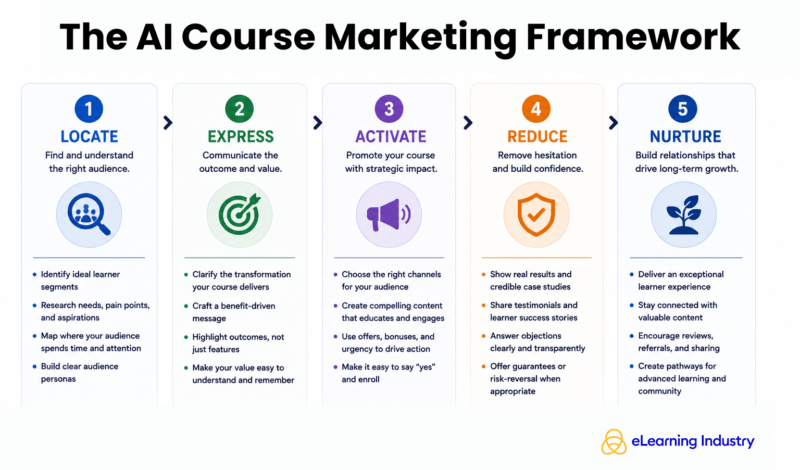
L — Locate The Priority Learner
Define the role, capability level, use case, and buying context.
E — Express The Business Outcome
Translate course content into clear workplace and career value.
A — Activate Trusted Channels
Use research and insights, thought leadership, webinars, partnerships, LinkedIn, email, and industry media.
R — Reduce Enrollment Risk
Provide proof, previews, clear prerequisites, instructor authority, and transparent outcomes.
N — Nurture Application And Advocacy
Support completion, workplace use, reviews, referrals, renewals, and expanded training.
Measure AI Course Marketing Performance
If you want to understand how to market AI training courses online, look beyond leads and registrations. Your brand strategy for growth should connect activity with sales, learning, and business outcomes.
- Awareness: Track reach, branded search, video views, webinar attendance, share of voice, and instructor visibility.
- Acquisition: Monitor landing-page conversion, cost per lead, cost per enrollment, email growth, applications, and webinar-to-course conversion.
- Sales: Measure leads, consultations, proposals, pilot conversion, contract value, sales-cycle length, pipeline.
- Learning: Track attendance, completion, assessment improvement, projects, satisfaction, and skill confidence.
- Application: Measure workplace use, time saved, workflow adoption, output quality, manager feedback, risk reduction.
- Growth: Track repeat enrollment, referrals, reviews, corporate cohorts, renewals, upsells, lifetime value.
Common AI Course Marketing Mistakes
- Targeting everyone interested in AI instead of using training needs analysis.
- Promising learners they can "master AI" without defining a practical outcome.
- Promoting modules instead of workplace results.
- Failing to separate beginner and advanced learners.
- Using one funnel for individuals and enterprises when you should learn how to promote corporate AI upskilling differently.
- Relying on the AI trend instead of creating a differentiated offer.
- Offering no sample learning experience.
- Using fear-based job-loss messaging.
- Overpromising productivity or income.
- Hiding instructor experience.
- Ignoring governance and responsible use.
- Treating certification as valuable without explaining what it validates.
- Driving traffic to weak course pages.
- Measuring registrations without completion or application.
- Failing to update programs.
- Selling an academy before validating a workshop or pilot.
- Using artificial scarcity.
- Publishing generic AI-generated promotional content instead of proven IMC marketing examples to promote AI courses.
How eLearning Industry Can Help Your Market Your AI Training Courses
Creating a strong AI training program takes expertise, but reaching the right buyers requires trusted distribution. If you want to market AI training courses, you need to get in front of L&D leaders, HR decision-makers, training buyers, learning technology professionals, and corporate education teams who are actively looking for workforce upskilling solutions.
This is where eLearning Industry can become a valuable distribution and authority partner. Through sponsored articles, thought leadership, webinars, eBooks, newsletters, podcasts, and original research, you can share your expertise with a highly relevant professional audience. You can also use directory visibility, lead generation campaigns, academy partnerships, and course-provider opportunities to increase your reach.
For providers focused on AI workshop marketing, targeted exposure can help you connect with organizations looking for practical training. Likewise, corporate training marketing becomes more effective when your content reaches business leaders who already understand the need for AI skills. You may have excellent subject-matter expertise, but trusted distribution and industry authority can help you turn that expertise into qualified opportunities.
Key Takeaway
The AI training market offers significant opportunities, but demand alone will not fill your courses or bring corporate contracts. You need to make your offer relevant to a specific audience, connect it to a practical problem, and show buyers what they can achieve after training. At the same time, your marketing should reflect the different needs of individual learners, managers, L&D teams, and business leaders.
Whether you offer workshops, certifications, self-paced courses, or enterprise programs, focus on practical outcomes and credible proof. Show how your training can improve workflows, strengthen AI skills, support safer adoption, and help organizations turn AI investments into measurable results. Then build a funnel that guides prospects from initial awareness to enrollment, consultation, and long-term engagement.
If you are learning how to find corporate clients for AI training, combine thought leadership with targeted outreach, webinars, assessments, partnerships, and industry visibility. This approach can also help you sell AI training to companies by connecting your expertise to their workforce priorities and AI implementation strategy.
eLearning Industry helps AI educators, training consultancies, course creators, universities, and corporate learning providers promote their expertise through thought leadership, webinars, eBooks, podcasts, newsletters, original research, targeted lead generation, and industry visibility. By combining educational content with trusted distribution, providers can move beyond general AI interest and connect their workshops, certifications, and upskilling programs with the professionals and organizations most likely to invest.
FAQFocus on the practical outcomes learners will achieve, then promote the course through content marketing, SEO, webinars, email, social media, and partnerships.
Depending on the course, audiences can include business leaders, employees, educators, developers, marketers, HR professionals, and career changers.
Use targeted LinkedIn campaigns, email marketing, industry communities, partnerships, webinars, and early-bird offers to attract registrations.
Show how the training addresses specific business needs, improves workforce capabilities, and delivers measurable outcomes, then target HR, L&D, and business leaders.
LinkedIn, search engines, email, webinars, industry publications, podcasts, and partnerships are particularly effective for reaching professional audiences.
Differentiate through a clear niche, practical projects, expert instructors, recognizable credentials, real-world examples, and demonstrable learner outcomes.
It should clearly explain the value proposition, target audience, curriculum, instructor expertise, outcomes, testimonials, pricing, FAQs, and a strong call to action.
Use thought leadership, LinkedIn outreach, webinars, case studies, gated resources, industry events, and targeted campaigns aimed at decision-makers.
Yes. Webinars demonstrate expertise, provide immediate value, answer questions, and give potential learners an opportunity to experience the instructor before purchasing.
Pricing should reflect the audience, course depth, instructor expertise, delivery format, credentials, and business value, with separate pricing for individual and enterprise buyers.
Track website traffic, lead volume, conversion rate, cost per acquisition, enrollment rate, revenue, customer acquisition cost, and learner retention.
They can showcase instructor credentials, learner success stories, industry partnerships, certifications, case studies, reviews, and practical evidence of training outcomes.
Emphasize their career and professional value through SEO, LinkedIn content, webinars, employer partnerships, alumni stories, and targeted campaigns.
Individual marketing emphasizes career growth, skills, and affordability, while B2B marketing focuses on workforce capabilities, business outcomes, scalability, and ROI.